In April 2026, Intact Global hosted it’s second annual conference, and the Genital Autonomy Collective presented on why inclusive activism is necessary and how to do inclusive activism. This post is an edited version of that presentation. Alliana began the talk and I stepped up halfway through to finish the talk.
Alliana Arshad:
Hello. I’m Alliana Arshad, founder of the Genital Autonomy Collective. I want to talk about why inclusivity is important in the genital autonomy movement, and a really key example of that is community building.
I founded the Genital Autonomy Collective in 2022 because I couldn’t find inclusive support for my own violated genital autonomy that included me in a way that I could feel understood while not being judged, which was how Leif Thompson described it yesterday, which is brilliant. We focus on marginalized people through intersectional genital autonomy. Genital autonomy is the idea that each person should have sovereignty over their own genitals. Intersectionality is a mode of analysis developed by Kimberlé Crenshaw to understand how forms of oppression multiply each other. The example that is given often is a company hiring Black men and white women but not Black women. In that example, the Black women’s experience of oppression can’t really be described by sexism or racism alone or even by trying to simply “add” sexism and racism together. Intersectional genital autonomy acknowledges that people’s experiences of violated genital autonomy, including unwanted circumcision, depend upon multiple lines of meaning including sex, sexual orientation, gender modality, religion, and race.
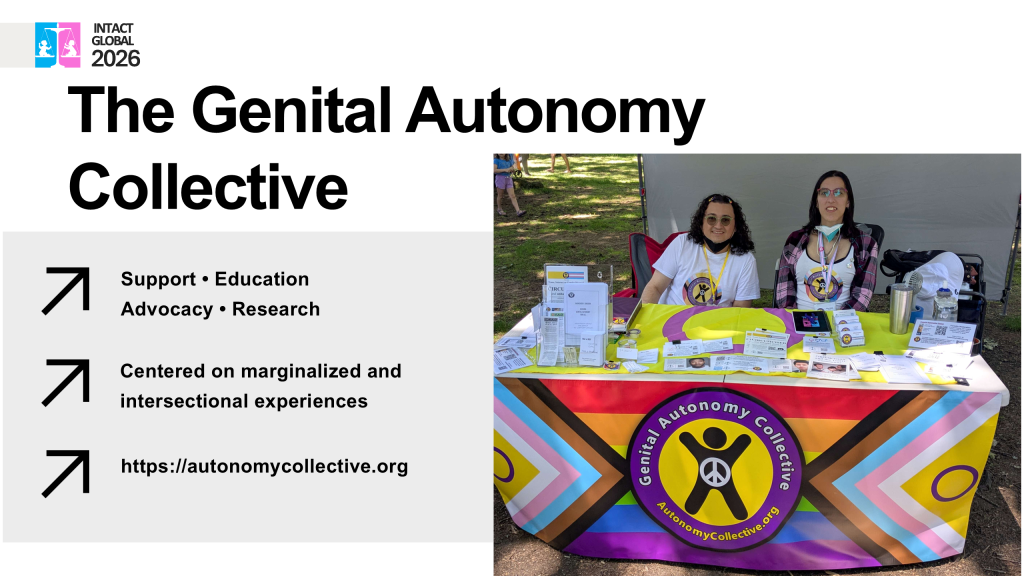
The Genital Autonomy Collective has been really busy since its founding. We started with explicitly inclusive groups for intersex, trans, and gender-expansive people who’ve experienced violated genital autonomy of all kinds, including male and female circumcision and intersex surgeries. Our peer support groups are also for people exercising their genital autonomy through foreskin restoration, labia stretching, genital piercings, and gender-affirming care. We’ve tabled at several Pride Festivals: Portland Pride in 2024 and 2025, the Trans General Assembly, and even Radical Pride in 2025. We host bike rides in Portland to raise awareness.
We’ve completed a collaborative autoethnography describing our experiences of violated genital autonomy and the difficulties we’ve encountered within the anti-circumcision movement. That article is under review at the Journal of Bodies, Sexualities, and Masculinities and should be published later this year. Based on that work, we’ve presented original research on the harms of circumcision at the GLMA Annual Conference on LGBTQ+ Health and the First Symposium of the International Society of Nonbinary Scientists. We’ve collaborated with GALDEF, a member organization of the World Association of Sexual Health, to share our stories alongside other sufferers of unwanted genital cutting. We have more planned for 2026.
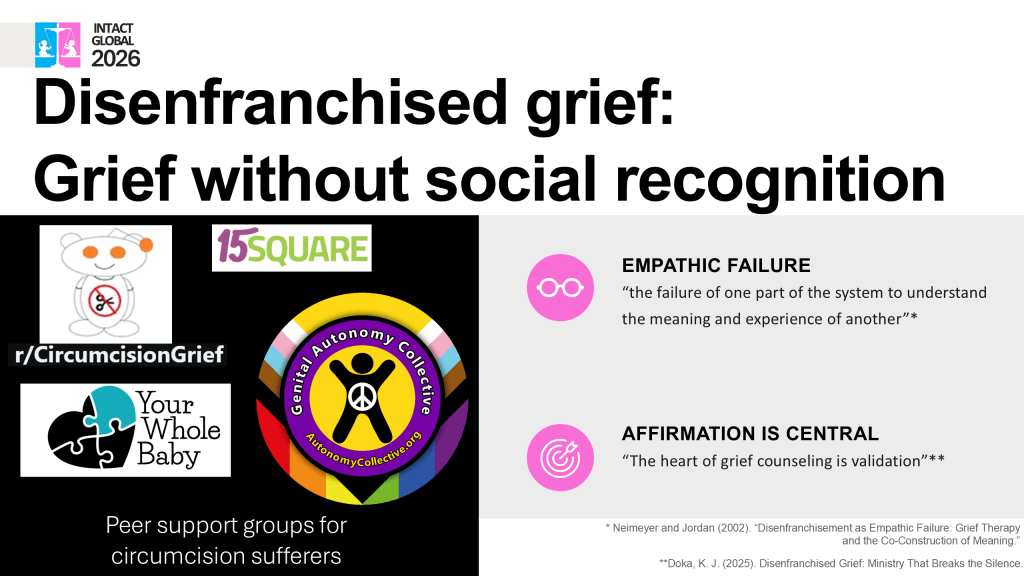
Many people listening have probably experienced disenfranchised grief. Disenfranchised grief is any grief that lacks social recognition. Even if this term is new to you, if you are a circumcision sufferer, you’ve almost certainly personally felt disenfranchised grief. What is the wildest response that you’ve gotten from a therapist seeking support for circumcision harm? Did you feel validated? Did the therapist recognize your grief?
So, a man and a woman walk into a therapist’s office. The man says, “I’m unhappy with my circumcised penis.” The therapist responds, “I’m circumcised, and it doesn’t bother me. You must be confused.” The woman says, “I’m unhappy with my circumcised penis.” And the therapist responds, “Well, just get vaginoplasty, and then it won’t matter. Why should you care about your penis?” Both of these responses are invalidating and disenfranchise the man’s grief and the woman’s grief in different ways.
My wildest response from a therapist was, “Do you feel like you have to be a woman because you’re circumcised?”, and I’ve literally been told “There are starving children in Africa.” That’s like just the the king statement of invalidation. I couldn’t believe it.
Because grief around violations of genital autonomy are so disenfranchised due to empathic failure of our mental health care system to understand circumcision sufferers, peer support groups are really the primary way to find validation.
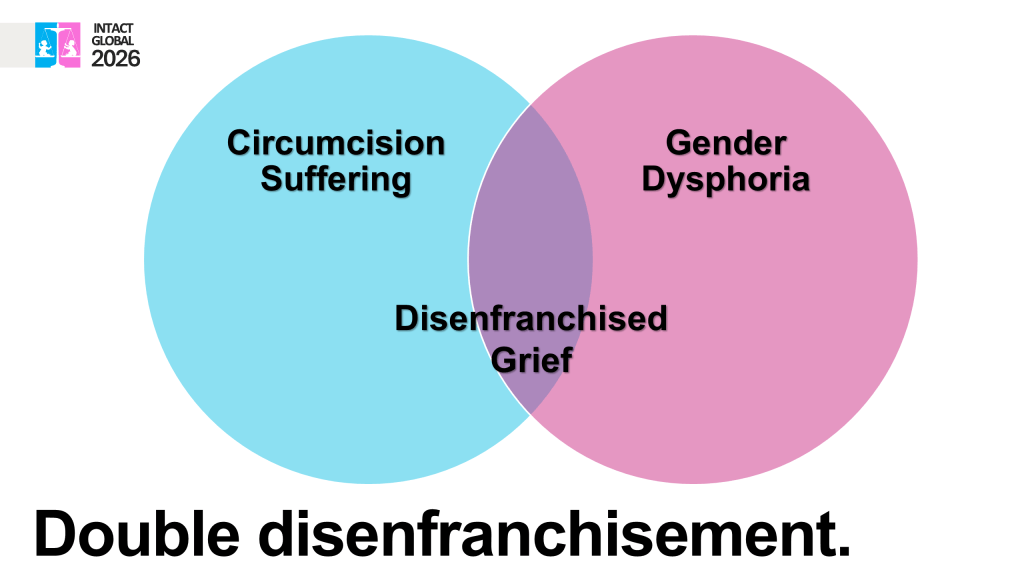
Here’s where intersectionality comes back in to the story. Because most circumcision sufferers are cisgender boys and men, most peer support groups are focused on the experiences of cis boys and men. People who don’t belong to those categories have a harder time finding affirmation and support for circumcision grief. It might be possible to find peer support that validates cisgender experiences of circumcision, but that same group might disenfranchise trans, intersex, and gender-expansive experiences.
On the other side, queer support groups might validate and recognize grief around gender dysphoria, but not grief about violations of genital autonomy. This double disenfranchisement can be examined through an intersectional lens.
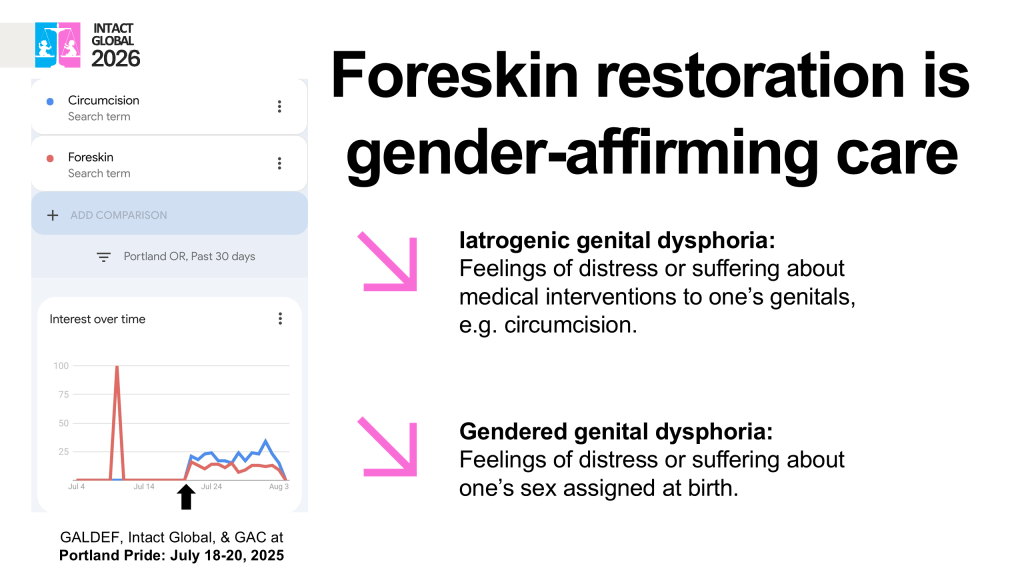
Most of you attending the conference today are probably familiar with non-surgical foreskin restoration. I’d be surprised if anyone here isn’t, especially if they were here yesterday to see Ron Lowe’s presentation. So some people engage in foreskin restoration to address dysphoria that they feel about their genitals where dysphoria means a deep and persistent distress or suffering that goes to the core of oneself. We’d like to highlight two different (though related) forms of dysphoria.
Iatrogenic genital dysphoria meaning feelings of distress about medical interventions to one’s genitals, including circumcision. Some cis boys and men choose to address genital dysphoria through foreskin restoration. It’s very important to note that not all restorers feel dysphoria or are motivated to restore because of dysphoria. Other reasons restorers give include to gain the practical benefits of a foreskin or because restoration gives a sense of euphoria.
More widely known is gender dysphoria which is distress about one’s sex characteristics. This dysphoria can interact and overlap with iatrogenic gender gender dysphoria.
For some trans, intersex and gender expansive people, foreskin restoration is part of gender-affirming care. It can improve vaginoplasty options and outcomes as well due to just having more erogenous genital tissue and reducing complications from having to get tissue grafts from outside the genital area. And for others, it is part of an empowering journey to reverse what is essentially a sex-imposing surgery that was performed because of sex assigned at birth.
This panel on the left of the slide shows Google search trend results for foreskin had a sustained increase after GALDEF, Intact Global, and the Genital Autonomy Collective collaborated to run a table at Portland Pride 2025. The queer audience is especially receptive to our message of genital autonomy and we’ve had a lasting impact on our local queer communities.
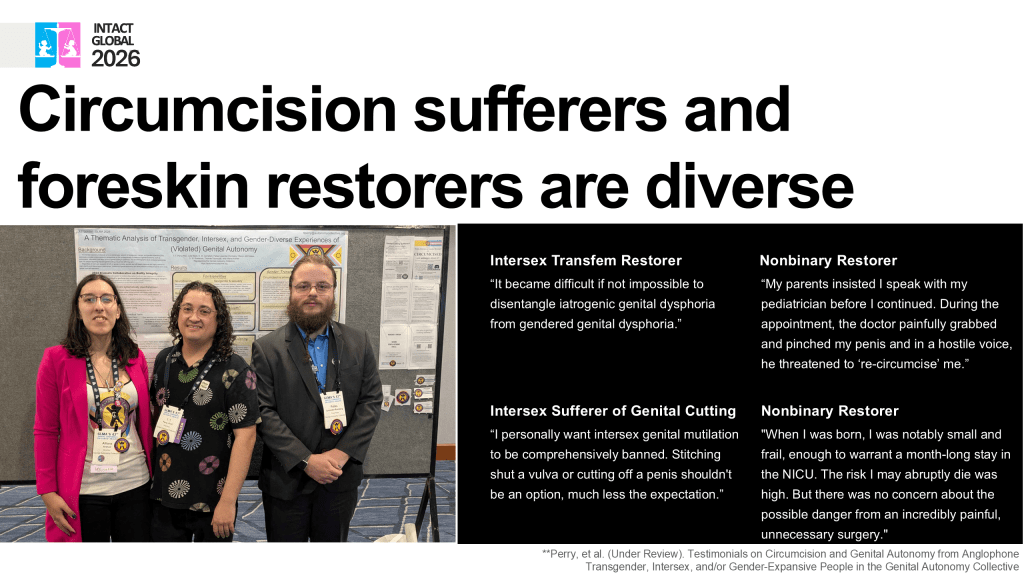
Circumcision sufferers and foreskin restorers are diverse, and we share the same grief as you. Our suffering is real, too.
This slide shows some pull quotes from our soon-to-be-published paper with the Journal of Bodies, Sexualities, and Masculinities. From my own testimonial: “It became difficult if not impossible to disentangle my iatrogenic genital dysphoria and gendered genital dysphoria.” And from another intersex co-author: “I personally want intersex genital mutilation to be comprehensively banned. Stitching shut a vulva or cutting off a penis shouldn’t be an option, much less the expectation.”
It’s just beneficial for everybody to be inclusive. For example, Walter at https://foreskin-restoration-devices.com produces devices that are inclusive of more anatomical variations, including vulvas. Walter’s work has resulted in device options for transmasculine people who want to stretch the clitoral hood or foreskin which often doesn’t grow as fast as the rest of the clitoris or “T-dick” when on testosterone. That same device is now being adapted for people with penises and can be used with less tissue, allowing people to passively restore earlier on into their their foreskin restoration journeys. So diversity and inclusion benefits everyone.
T. T. Perry:
Thank you, Allie. I’m T. T. Perry. I’m an applied and translational sensory scientist, but I’m not going to be talking about sensory science today. Instead I’m telling a very personal story. I was a teenage foreskin restorer. As a somewhat naive teenager, I followed my parents advice to talk to my pediatrician before continuing with the progress that I had made restoring my foreskin. During that appointment, the pediatrician grabbed my penis and violently pulled it toward him and told me that if I wanted him to help me that he would just re-circumcise me. Since then, I’ve found a lot of help through the Genital Autonomy Collective, including understanding my experiences as a non-binary person and as a circumcision sufferer. It was difficult to get that kind of support from conventional peer support groups. Because of my own difficulties, I know how important inclusion is and I want to talk about how to do inclusive activism.
If there’s just one idea that I’d like everyone to take away from my portion of the presentation, it’s that to reach people, you need to tell stories. And those stories will be most effective if they’re about belonging and connection rather than about villains and enemies. If you reach out to people with a desire for belonging and connection, you’re more likely to get that reciprocated. If you treat activism as a battle of wills with threats to be eliminated, then people are more likely to respond defensively.
Confrontational activism does get attention, and it has its time and place. Confrontation doesn’t always translate into real sustained support for genital autonomy. So I’d like to offer an alternative to adversarial or confrontational politics, and it’s called relational politics or the politics of belonging.
The core idea of relational politics is that who we love is who we are becoming. Relational politics presents you with a core set of questions that you need to think through when doing your activism. Whose grief can you easily recognize and validate? And whose grief is invisible to you and easy for you to dismiss? Whose pain touches your heart and calls on you, even compels you to take action? And whose pain do you justify? How can we expand our networks of love and care to include people who have been excluded in the past? These are the questions that we need to answer when we’re thinking about politics in a relational way.
So, here’s a concrete metaphor to think about adversarial politics. It’s kind of like a game of pool. There’s a table. There’s pool balls that are these hard solid objects that smash into each other. And to change the state of the game, you’ve got to knock a ball into the hole and take it off the table. It’s zero sum. For someone to win, someone else has to lose. and the pool balls themselves never change or evolve. A solid’s always a solid. A stripe is always a stripe. That’s adversarial politics.
What about relational politics? We can think of relational politics like weaving a tapestry. The fabric’s not complete. It’s in the process of being made. Individual threads don’t have much of a shape on their own, but together they make something bigger. Each thread is being bent and woven together which reflects the fact that we’re constantly creating and recreating ourselves through our relationships with other people. As the weaving of the tapestry progresses, these threads become entangled with new threads in different parts of the tapestry.
In the framework of relational politics, power isn’t exerted by hitting objects or eliminating enemies. In relational politics, power is about who you are emotionally connected to. It’s about which strands of the tapestry your thread can pull on because they’ve been woven together with your thread. Power is about who you love and whose suffering matters enough to you that you take action to answer their cries of pain by bending, changing, shifting to ease their suffering. When you hope for change in the future, you’re thinking about who you wish to become and who you wish to be connected to in the future to make those future connections.
Relational politics is also about recognizing that everyone, not just me, not just you, not just the people in the room, everyone has a very deep desire to feel like they belong. So, we have these two general approaches, these kind of adversarial politics and relational politics. And there’s a time and place for both. But I’d like you to think more about these ideas of whose grief matters to you and whose grief does not matter to you.
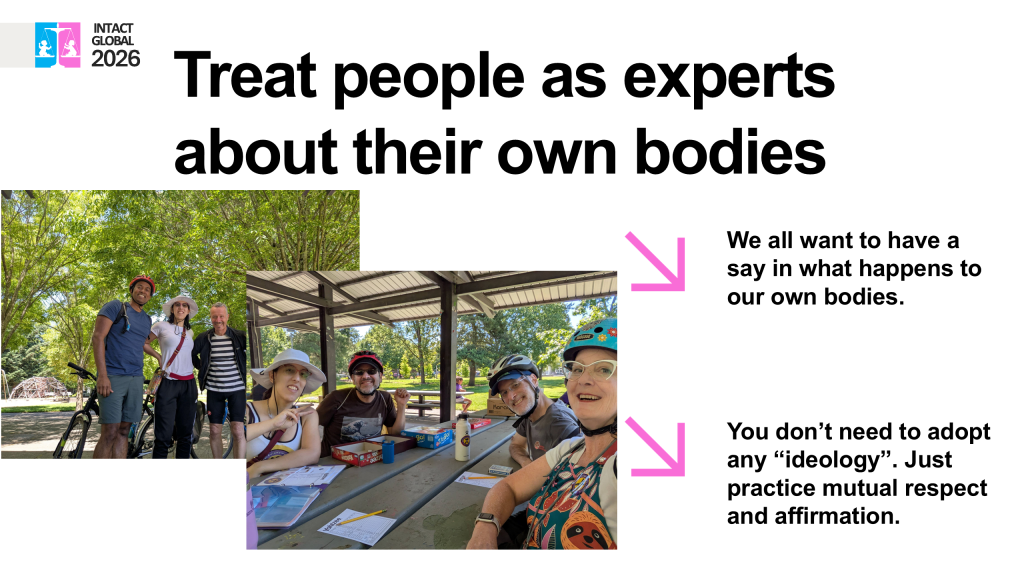
This can be as easy as starting with “I’m going to treat people as experts about their own bodies.” We all want to have a say in what happens to our bodies, whether that’s about circumcision or whether it’s about our sex characteristics. Treating other people with respect and affirmation invites others to treat you with respect and affirmation. And as Samer said yesterday, you don’t have to become one of those angry people to join the anti-circumcision cause. And similarly, you don’t have to become a trans person to support trans people. Instead, it’s not about adopting a set of beliefs. It’s about thinking carefully about your feelings and their feelings and finding an emotional connection. And that’s going to become increasingly important because anti-trans laws are also pro-circumcision laws.
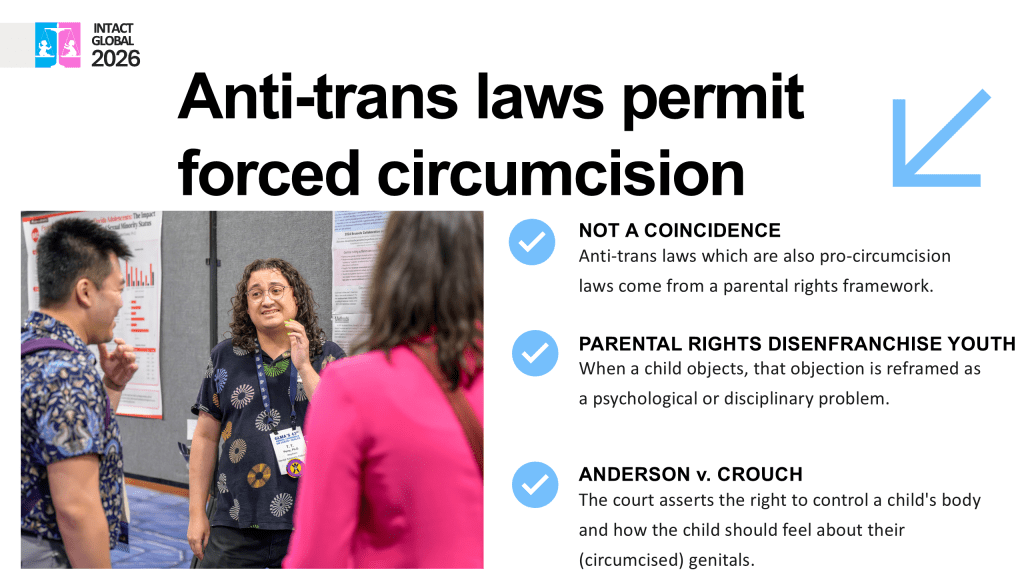
Even as we make progress toward building our big tent coalition, laws are being passed that enshrine forced genital cutting as a parental right. If you haven’t been paying attention to the attacks on trans people in the U.S., here’s a wake-up call. U.S. states have been passing laws targeting and restricting the freedoms of trans people, but those same laws contain provisions explicitly permitting forced genital cutting, including circumcision. It’s not a coincidence. That’s because they have one framework, the parental rights framework. Parental rights are a machine for disenfranchising youth and creating disenfranchised grief. If a child objects, then their objection is re-framed as a psychological disturbance or a disciplinary problem. And this is true whether we’re talking about children objecting to circumcision or children who have gender dysphoria.
In particular, I want to flag this case Anderson v. Crouch, which is a case out of West Virginia about Medicaid funding for gender-affirming care. And the appeals court in this case stated that the state may have a legitimate interest in encouraging people to appreciate their sex. And I really want this to sink in what that means. An appeals court asserted a state interest to not just control the physical status of our bodies against our will, but went further and said that the state could have a legitimate interest in coercing people to love and accept their genitals, which for many people means loving and accepting their circumcised genitals.
I hope you can see that that is a danger for the genital autonomy movement. And so to fight back, we’re going to really need a united coalition, trans, intersex, gender-expansive people together with cisgender circumcision sufferers.
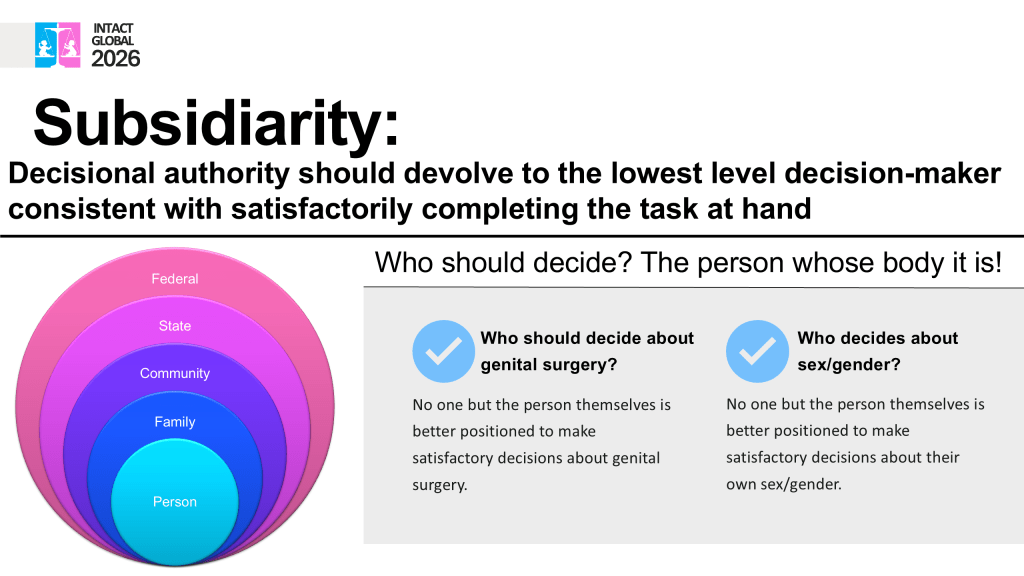
I’d just like to end by offering a uniting principle that can help us build that big tent coalition, and that’s subsidiarity.
This is a principle that spotlights the question of who who should make decisions. Under subsidiarity, decisional authority should devolve to the lowest level decision maker consistent with satisfactory completing the task at hand. And each larger social group should offer support and aid to the lower level decision makers rather than making the decision for them. Subsidiary operationalizes autonomy while balancing legitimate competing interests like bodily integrity.
So, who should decide about genital surgery? To answer this question, the first step is to ask who is best positioned to make a satisfactory decision, and the answer is no one but the person whose body it is is better positioned to make satisfactory decisions about genital surgery. Who decides about sex/gender? The answer is similar: No one but the person themselves is better positioned to make a satisfactory decision about their own a person’s sex/gender. Again, we all want to have a say about what happens to our bodies, especially our genitals.
Thank you for your time today. Check out the Genital Autonomy Collective at autonomycollective.org and if you’re an intersex person who has experienced violated genital autonomy, get in touch for support or even to become a plaintiff.
To cite this:
Perry, T. T. & Arshad, A. “Our Grief is Real, Too: Creating Inclusive Activism Together”. Intact Global 2026 Conference, Los Angeles, April 2026. https://ttpphd.com/2026/05/05/our-grief-is-real-too-intact-global-2026/
 TTP, PHD
One response to “Our Grief is Real, Too: Intact Global 2026”
[…] original research at GLMA‘s 43rd Annual Conference on LGBTQ+ Health, and spoke about inclusive activism at the 2nd annual Intact Global Conference. This work is intended to fill the gap that has been […]